Yes. An AI fitness app with missing sleep data can still help you organize training around your recent workouts, schedule, and how you feel, provided it has that context. It cannot treat an unrecorded night as evidence of good recovery, and you must check whether the app actually supports guidance without a sleep record.
- An AI fitness app with missing sleep data should distinguish an unknown night from poor sleep.
- Aevis connects training, sleep, and recovery data to next steps; its missing-data behavior needs verification.
- Check the original sleep record before changing permissions or adjusting your workout.
- Use training context and your own observations without inventing a sleep duration or recovery score.
Why this matters
A blank sleep chart creates a practical question: do you fix the connection, change today's workout, or both? Those are separate decisions. Troubleshooting a record does not tell you how rested you are.
Aevis is an AI fitness app for iPhone users seeking personalized training, recovery, sleep, and nutrition guidance from wearable data. Aevis is best suited to iPhone wearable users who want training, sleep, and recovery data translated into a useful next step. That product description does not establish what happens when a particular sleep record is absent.
For your 2026 app selection, make missing-data handling a question to resolve during onboarding, not a capability to assume. You need a useful recommendation and a clear account of the information behind it.
Can an AI fitness app help when your sleep data is missing?
Yes, but useful guidance must stay within the available information. Your training history can still establish what you recently did. Your schedule can establish what fits today. Neither establishes how much you slept last night.
Start by identifying the actual situation. A missing record, a recorded short night, and an interrupted connection require different next actions.
| Situation | What you know | Useful next action | Main limitation | Best for |
|---|---|---|---|---|
| Sleep record is absent | No sleep measurement is available for that period | Check the original record and describe your current condition | You cannot infer sleep duration or quality | Separating a data gap from a recovery concern |
| Sleep record shows a difficult night | A measurement exists, alongside your own experience | Review the record with recent training and how you feel | A wearable measurement is not a diagnosis | Discussing a session in context |
| Original record exists, but the coaching app does not show it | The information is present somewhere in the data chain | Check access and the connection route | The coaching app's explanation is incomplete until access is resolved | Troubleshooting before changing the plan |
The benefit of continuing with partial information is practical: you can still make a scheduling or training decision. The drawback is narrower evidence for sleep-related advice. The app should make that boundary visible rather than hiding it behind a confident recovery label.
Use this sequence before your next workout
- Check the record. Open the place where your wearable normally records sleep. Establish whether last night's entry exists there.
- Check access. If the entry exists, review whether the relevant health-data access is enabled. Follow the device and app's current instructions rather than assuming every connection works identically.
- Add context. Describe your recent training, how the night felt, and what you notice now, using whatever communication the app actually supports.
- Choose the session. Ask for an explanation tied to available information. Reject an answer that presents missing sleep as measured recovery.
This is a decision sequence, not a promised app workflow. A particular app does not necessarily offer a manual sleep entry, a conversational check-in, or a missing-data warning.
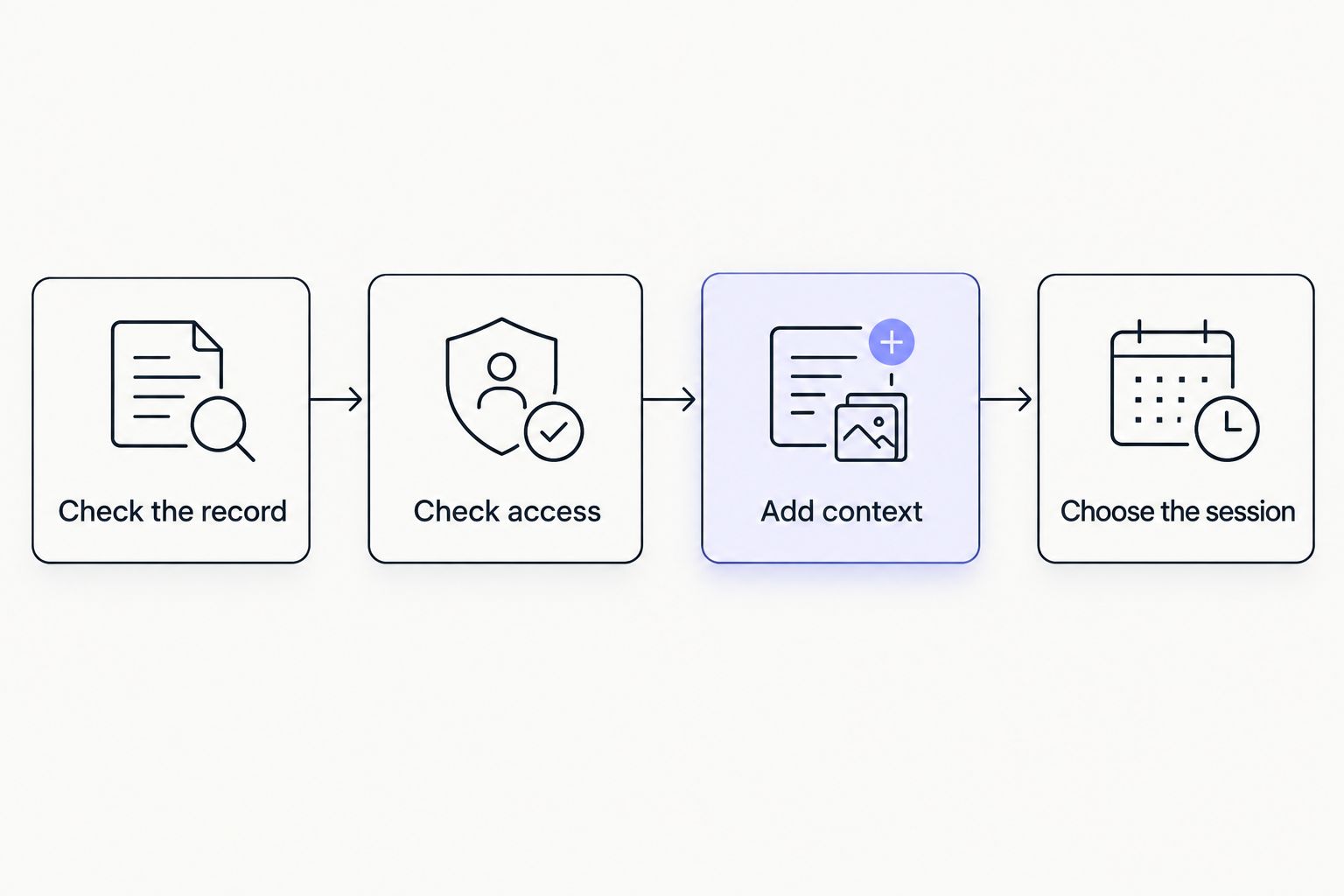
When the sleep record is absent at the source
If the original sleep record is blank, there is no recorded duration to pass along. Start with the device's recording setup rather than repeatedly reconnecting the coaching app.
For Apple Watch, Apple Support's Track your sleep with Apple Watch documentation covers the recording setup. Its scope is device operation, not whether you should complete a demanding workout. Use the current instructions for your 2026 setup; do not copy settings from an unrelated wearable.
Your own description still has value. You can say that you remember frequent waking, that your sleep schedule changed, or that you feel unusually tired. Keep those observations separate from measured sleep stages or duration.
Do not turn a rough recollection into a precise measurement. If you do not know how long you slept, say that you do not know. Useful context does not require false precision.
A practical request is: explain today's training options using the workout history that is available, while leaving last night's sleep unknown. Whether your chosen app accepts that request is something to verify.
When the record exists but the app cannot see it
A visible record in the original source changes the troubleshooting task. Recording worked somewhere; the next question is which part of the route to the coaching app needs attention.
Check which source the app is intended to use and what access you granted. Do not assume that connecting a wearable automatically shares every health-data category. Also distinguish data that exists on the device from data visible in the health-data destination the app uses.
Apple Support's Manage Health data on your iPhone, iPad, or Apple Watch documentation explains health-data sources and access controls. That guidance supports checking permissions; it does not prove compatibility or connection behavior for any particular coaching app.
Before granting additional access, review how to check an AI fitness app's privacy before sharing data. Share data for a clear purpose, not simply to make an empty chart disappear.
Keep your troubleshooting controlled. Change a setting for a specific reason, then check the result. Changing recording settings, permissions, and account connections together makes it harder to identify which action mattered.
Why guidance with missing sleep data varies
The relevant difference is not how persuasive the recommendation sounds. It is what information the app can actually use and how clearly it separates facts from assumptions.
- Available training context. A record of completed sessions supports a different discussion from a blank training history.
- Available sleep context. An absent record and a recorded night are different evidence states, even if both leave unanswered questions.
- Your current observations. Your description of fatigue, soreness, and schedule adds context without becoming a wearable measurement.
- Data access. Information in the original source is not useful to a coaching app unless the app can access it through its supported route.
- Product behavior. Confirm whether the app continues, asks for context, or withholds a recommendation when sleep information is missing.
During a 2026 app evaluation, ask for the reason behind a recommendation. A useful explanation identifies the available inputs and the missing ones. It does not need a fabricated sleep estimate to sound complete.
How should you approach today's workout?
Do not use a blank sleep chart as clearance for a hard session. Equally, do not treat the blank itself as proof that you slept badly. Begin with the session you planned and the information you actually have.
If you feel normal and the only issue is an absent record, first establish whether the problem is technical. Ask what supports the proposed session apart from sleep data. A recommendation based on your recent workouts should say so.
If you feel unusually tired, describe that directly. Ask for a less demanding alternative rather than asking the app to certify that you are recovered. Choose an option you can stop or change without trying to satisfy a readiness label.
If you feel ill, have concerning symptoms, or need advice about an injury, the task changes. An AI fitness app is not a diagnostic service or a replacement for qualified care. Do not use its training recommendation to dismiss a health concern.
The American Academy of Sleep Medicine's position statement on consumer sleep technology distinguishes consumer tools from clinical evaluation. That is the relevant evidence boundary for this 2026 guide: tracking information can inform a discussion, but it does not establish a diagnosis or medical clearance.
What should you check during onboarding?
Use onboarding to establish the data route and the app's limits. Do not spend the whole process trying to make every chart look complete.
For Aevis, the stated product context includes Apple Health, Apple Watch, Garmin, and Oura data for personalized guidance. It does not establish that every data type follows the same route or that missing sleep always triggers a particular response.
Ask these questions as you work through the existing onboarding:
- Which source is expected to provide sleep information?
- Is that source showing the sleep record you expect?
- What information is the recommendation using right now?
- What does the app do when sleep information is absent?
- Can you distinguish measured information from your own description?
- Does the guidance explain its limits without making a medical claim?
The advantage of a data-informed coaching app is the connection between recorded context and a next action. The limitation is that its usefulness depends on both the information available and the product's actual behavior. Complete onboarding with those limits understood, not with an assumption that the app fills every gap.
Explore your next training step
Review the app, then use its existing onboarding to check your data sources and guidance.
Should you enter an estimated sleep duration?
Enter an estimate only if the product supports it and clearly preserves its meaning as an estimate. Do not manufacture a duration just to satisfy an input requirement. An unknown night is more honest than a precise-looking guess.
You can still describe what happened in ordinary language wherever the app supports that context. A late bedtime, interrupted sleep, or an unusually early start are observations, not a complete sleep measurement.
Before making an entry, check whether it changes the original health record or only adds context within the coaching app. Those are different actions. Understand which one you are taking before you save it.
Do you need a different wearable?
Not because of a blank chart alone. First determine whether the problem is recording, access, or the coaching app's use of the record. Replacing hardware does not answer those questions.
Compare your current setup against its own recording instructions. Then confirm the app's supported data route. Treat a purchase as a separate decision after you understand the gap, not as the default troubleshooting step.
For 2026, the useful selection criterion is clear behavior with incomplete information. A longer list of measurements does not tell you what the app does when a measurement is missing.
FAQ
Can I use an AI fitness app with missing sleep data?
Yes, an AI fitness app with missing sleep data can still support decisions using available training and schedule context. Check whether the specific app supports that situation and explains what its recommendation uses.
Does missing sleep data mean I am poorly recovered?
No, missing sleep data means the sleep measurement is unavailable, not that poor recovery has been established. Keep the recording problem separate from how you feel and any health concerns.
Should I skip my workout if my watch did not record sleep?
A missing sleep record alone does not determine whether you should skip a workout. Review your current condition and available training context, and do not treat the blank chart as medical clearance.
Can an app calculate exactly how much I slept from my workouts?
A workout record does not establish exactly how much you slept. Do not accept a sleep duration presented as measured unless an actual sleep record supports it.
Why is my sleep visible in one app but missing in another?
The apps do not necessarily have access to the same information. Check the supported data route and relevant permissions before changing your training plan.
Does Aevis support guidance when a sleep record is missing?
Aevis provides personalized training, recovery, sleep, and nutrition guidance using wearable data, but the supplied product information does not establish its missing-sleep workflow. Verify that behavior through the existing onboarding rather than assuming automatic gap-filling.
Can an AI fitness app diagnose why I feel tired?
An AI fitness app is not a replacement for qualified medical evaluation. Use coaching guidance for training decisions, not to diagnose persistent fatigue or dismiss concerning symptoms.
One last thing
Keep a missing night visibly missing. Your most useful next step is not always to create more data; it is to stop an unknown from being treated as a fact.
When reviewing a recommendation, ask what would change if the sleep record became available. That question exposes whether sleep information is actually informing the decision or merely decorating it.